Wednesday, July 21, 2021

Cleaning Up

 I have some very talented and creative friends.  

One of my friends has been making soap.  She has become very passionate about it and very good at it.  In fact, she has become such a talented soap-maker that she no longer buys soap.  My favorite of her recent soap-making related quips was to quote her son, who lamented the fact that his mom no longer buys "normal" soap.  Hers is better.  So, why spend the money?  I will admit my admiration of her.  She's pretty amazing, actually.

She learned to make both a bar and a liquid soap, and even better than just keeping her family washed, the liquid soap can also be used for the dishes and the laundry.

I have made my own soap using lye and lard (I included a recipe in my book, Surviving the Apocalypse in the Suburbs: the Thrivalist's Guide to Life Without Oil*), but I never learned to make it into a liquid for laundry and dishes.  I guess I knew that my soap could be used for whatever (grated bar soap can be dissolved in water and mixed with borax and washing powder for liquid laundry soap), but it just never occurred to me to take it beyond washing my body.  

Soap can be expensive, and while there are definitely cheaper options than the one we use, as I've aged, I have developed some pretty significant sensitivities.  If I don't want to end up an itchy mess, I have to be very careful about what I smear on my skin.  

For personal hygiene, I have been buying Dr. Bonner's bar soap through their website.  I buy 10 bars at a time at a cost of about $5.05/bar including shipping.  It takes a week and a half to get here.  

Buying it locally doesn't save me much more.  The bars are around $4 each at places like Rite Aid, but I can't always get the flavor I want.  Since Dr. Bonner's isn't a brand that flies off the shelves, most places have a very limited selection of scents and only stock the most popular scents.  I can almost always find peppermint.  I almost never find almond, which is my favorite, especially during the winter. 

We use about five bars of soap per month for four people, two of whom use it full-body, including hair.  It works out to about $26.45/month for soap (buying it online). 

My friend is also making the liquid soap, which can be used like the Dr. Bonner's concentrated liquid.  According to their website, "Dr. Bronner’s 18-in-1 Pure-Castile Soaps are good for just about any cleaning task. Face, body, hair & dishes, laundry, mopping, pets" - basically everywhere in the house.  And it's diluted for most uses, which means a 32 oz bottle should last a while.  Thirty-two ounces of Dr. Bonner's concentrated liquid soap is $18.49 from their website (not including shipping).  It's about the same at the grocery store. 

I have never used Dr. Bonner's exclusively for the above listed tasks, because it's expensive, compared to other cleaners, even diluted.  According to this dilution cheat sheet on the Dr. Bonner's website, one would use 1/2c of Dr. Bonner's per load of laundry, which works out to eight loads of laundry per 32 oz bottle.  I mean, that doesn't sound right, to me, and, at over $18/bottle, it certainly isn't cost effective as a laundry soap, if those figures are accurate.  

I reckoned that making my own soap could save us some pretty pennies.  So, I asked my friend to teach me to make her soap.  She was delighted to help me, and we set a date.

She stopped by for a few hours the other day with some soap making supplies: a whisk, a dedicated plastic container for mixing lye, some potassium hydroxide (a.k.a. potash (KOH) for making liquid soap), and some molds for the bar soap.  I had purchased coconut oil and lye (Sodium Hydroxide, NaOH), and I always have a good supply of essential oils, which are optional and can be omitted, if the soap maker prefers.

The process was so simple.  Basically, melt the coconut.  CAREFULLY, mix the lye or potash with water (it gets hot, so great caution is necessary!).  Blend the two, and stir, and stir, and stir ....

After much stirring (my friend uses a stand mixer, which she sets and leaves so that she can do other stuff while the soap is processing), the liquid soap compound takes the consistency of marshmallow fluff.  It is, then, transferred to a container (I reused a polypropylene container that had originally been used for mixed nuts) and sequestered (my friend's word, which she said means just putting it out of the way for a bit).  Overnight, the mixture thickens from a fluff consistency to a mashed potato consistency, and according to my friend, it's done!

My friend advised diluting 3:1 (water/soap) for a liquid soap that can be used for whatever purpose.  If wanted, essential oils are added at this last stage, just before use.  It actually smells like soap - clean and fresh.  I think I like it without any essential oils, just the way it is.  

The bar soap was pretty much the same steps.  Melt the coconut oil.  Mix the lye with water (again, carefully, because it does get hot).  Allow to cool.  Mix lye water with coconut oil and stir.  When it thickens to the consistency of pancake batter, add essential oils and pour into molds.  We used a silicone bunny-shaped mold, and I was able to remove the soap from the mold the next morning.  It will have to "cure" for another two weeks or so before we use it. 

The recipe my friend used measures in grams.  I used a handy-dandy internet converter.  It's, basically, 30 oz (840g) of coconut oil (I found 15 oz bottles of coconut oil for $3 each at the dollar store); 1/4lb (114g) of lye (Amazon lists a pound container for lye for $11.99); and 234g of water (about 0.99 cups).


The bar soap recipe makes around 12 standard-sized bars, which (excluding the cost of the essential oils), works out to $0.75/bar.

By teaching me to make this soap, my friend has saved us around $255/year on bar soap.

I won't know how much she saved us on laundry and dish soap until I get a good sense of how quickly we go through that container, but every little bit helps, right?


Being a real housewife is not a TV drama.  It's also not "just" about doing laundry and making dinner.  We, "Real" Housewives, are economists, whose the goal is finding ways to be financial savvy in our home care.  

Where I live the average hourly wage earner makes $18/hour.  One has to work for 20 minutes to buy one bar of Dr. Bonner's soap.  That's a third of an hour, just to buy a single bar of soap.  

While it is true that I spent more than 20 minutes making my soap, I was also able to do other tasks while the soap was setting up (i.e. it doesn't require 100% of my attention for the whole process).  After measuring and mixing the ingredients, for instance, I could take a couple of minutes to put the clothes on the line, or go out in the garden and harvest cabbage for dinner, or go out in the farmyard and collect eggs.  All of those tasks also save us money.  

Contrary to what some may believe, Housewifery** is an incredibly skill-based "profession", and like so many industries that are hurting for skilled and talented workers, there are very few of us left who are knowledgeable in the true art of keeping a house.  When we lose our homemakers, we will all be dependent on other people to do the task of taking care of us, which means longer work hours and, ultimately, a lower quality of life.

The further we, as a society, get from being able to do such simple things as making soap, the more time we will spend trying to make money to compensate for our lack of skill.  


========================================


*This is not an affiliate link, but if you purchase a new copy of this book from the publisher's link, I do receive a residual.  

**This is NOT an affiliate link. I am not affiliated with Amazon and make no money if you choose to purchase this book.  


Monday, July 5, 2021

Face Masks and Rice Packs

Deus Ex Machina works at a corporate job in a manufacturing facility.  His employer is still requiring face masks.

At the beginning of the Pandemic, I made a bunch of masks for my family.  As the pandemic wore on, I made a few more to cut down on having to launder them as often.  Over the course of the last year, I have made just over a half dozen different masks for Deus Ex Machina to use at work.    

He has been wearing those masks, one a day, every day, five days a week, for more than a year.  

The masks are holding up surprisingly well, given how much they are used, but recently, we learned that his employer does not have a plan for going full mask-free, and so, I made him a few new ones today, with a very summery vibe - one for each day of the week.  


These are all reversible (two of them have the same color fabric on both sides) and are made from a quilter's weight cotton fabric - breathable, but with a tight enough weave to keep out virus particles - as was recommended last year when everyone was making homemade masks.

Since I have a sizeable fabric stash (much of which was given to me by a dear friend who is no longer quilting), and I save elastic from everything, I didn't need to purchase anything to make these.

If Deus Ex Machina had been purchasing masks, he would have paid, for a comparable product, $4 each.  Today's five masks would have cost $20.  I made them, excluding my time and the electricity for my sewing machine, for free. 

Over the year of making all of these masks, I have cut out extra mask panels on a few occasions, and so I had several fabric rectangles in my stash.  I was looking at them today, thinking, I should sew them all together.  I would have the beginnings of a quilt.

Then, I walked into the kitchen to get another cup of coffee.  


Many years ago, we bought a set of lavender infused rice packs, which we store in the freezer.  When the girls were young the rice packs were dubbed, "Cold Things."  Every bump or bruise called for the getting a "cold thing" from the freezer.  In our house, they're better than band aids for curing what ails you.   And we use them for everything from keeping cool on those wicked hot summer nights when it's hard to sleep in our non-air conditioned home and the fans just aren't doing it to a cold compress o his forehead when Deus Ex Machina has one of his migraines.  

Suffice it to say that our "cold things" were well used, and as a result, over the years they've gotten a little ragged.  One of them even developed a hole, which someone tried to stitch closed.  It still lost a few pieces of rice with every use.  Also, recently, I noticed that several of them had something sticky on them, probably from something that leaked on them in the freezer.  I hate touching sticky stuff.  

But I was at a loss as to how to clean them without compromising the rice that was in the pack.  I mean, I couldn't just throw them in the washer. 

I was planning to replace the old fabric ... at some point.

This morning, after I made Deus Ex Machina's new summer masks, I walked in the kitchen for some coffee, and there, on the counter, was one of the sticky cold things.  

So, I grabbed it and brought it out to the table where I had my sewing machine set up.  I, quickly, sewed four mask panels together, cut open the old cold thing, and transferred the contents into the new cover.  I also added a handful of dried lavender flowers we just happened to have in the cupboard - leftover from some salve or soap project were were doing in the past.


All total, I made three new rice packs using leftover fabric from my mask making, rice from the old cold things, and a handful of dried lavender leftover from some other project.

Out or curiosity, I looked up the cost of a new lavender infused rice pack.  I found these for $19.99 ... EACH.  

Today, I saved $79.97 for the rice packs and masks that we didn't have to purchase.  


Friday, July 2, 2021

How a non-wage earning Housewife MAKES More Than a Minimum Wage Worker

We have this great family story.

When Big Little Sister was three or four years old, Deus Ex Machina worked for a company that made the equipment used by the CD manufacturing industry to put the shiny metal on the discs.  It was a fascinating process, and the machines were pretty cool looking, too.

He was, rightfully, very proud of his work in assisting with the engineering of this machine, and so he brought us into the facility for a tour so that we could see it in action.  It was impressive.

A few days later, out of curiosity and to see if Big Little Sister understood what he did for a living, he asked her, "Do you know what Daddy makes at work?" 

Without skipping a beat, she blurted, "Money."

I think about that ... a lot ... because money is something that I don't make a lot of, and sometimes I feel the weight of a society that doesn't value people who don't earn a wage.  I've heard it in exactly those terms from more than one person, who intimated that my value - or lack thereof - was connected to whatever I could make in dollars.  I make very few dollars, and so I am not worth all that much, to our society, according to those people.

The fact is, though, that I make a lot of stuff, like:

Just those things listed is $73.12 worth of goods.  

The minimum wage in Portland, Maine is $15/hour.  Someone working for minimum wage would have to work almost five hours in order to pay for those items I make.  

In the doing of those things, in the "making", I SAVE money.  If we subtract the cost of the breakfast sandwich, I saved $54,47, because I didn't pay for the materials to make any of those items.  It was all recycled.

It got me thinking.  The fact is, my being a full-time housewife saves a lot of money (overall), because I can do things, make things, sew things, iron things, plant things, grow things, clean things, cook things ... that we would, otherwise, have to pay someone else to do.

The average annual income for an hourly worker here in Maine is $39,327.   Assuming that's full-time, the average hourly rate in Maine is $18.90.  When I was working outside the home at a local community theater, I earned less per hour.  My job as a fact-checker pays more per hour, but I don't and won't get as many hours as I worked at the theater.  So, there will be less money.

But if I am home more, then, we save more, because I can do all of those things that we might end up paying someone else to do, and there are no job-related expenses (like gasoline for the car I needed to travel back and forth to work, which I don't need for that purpose now, because I don't have to drive to work).  

Today, I made Deus Ex Machina a breakfast sandwich ($9), packed his lunch ($7.50), did some housework ($40/hour), and ironed work clothes ($3/pants; $1.50/shirt).  The total "saved" today was $61.  A person making the average hourly rate here in Maine would have had to work three hours and 22 minutes to pay someone to do what I did today. 

Oh wait!  I also did some sewing ...

... but that will be another blog post.


I challenge you to calculate how many hours you must work to pay for some basic products and services.   Then, consider if your job costs more than you could save, by doing those things yourself and not earning a wage.


Wednesday, May 12, 2021

Fact Checking for the Win

 After the flurry of morning activity had died down, Deus Ex Machina was out the door with his belly full of homemade breakfast sandwich (with eggs from our backyard flock and a slice of ham from a Maine-based producer), a cup of home-brewed coffee-to-go, and his lunch packed neatly in his new lunch bag, I sat down for a couple of minutes of coffee and relaxation before I had to start part II of my morning flurry (tending the farm, showering, and ferrying Precious over to her friend's house).  

I have been on the Internet and on social media since its inception.  Back in the early days of human-to-human *computer-interfaced* interaction (what today's folks would call Facebook, Instagram, Twitter, etc.), we had email and message boards.  I learned a lot in those days about how not-to act and react with people online.  

It was a lot more anonymous back in those days, and so we could be a little less tactful, and many of us were.  I tried, in those days, to be very aware that on the other side of those printed words on the computer display, the moniker "H2OColor" was an actual person and not some faceless screen with disembodied hands typing on a keyboard and refuting my comments.

But what I also learned was to be very careful about what I put out there.  If I make assertions, I fact-check those comments to the extent possible, using as many resources as I can find.  I have been caught too may times with my proverbial pants down, by posting something that wasn't, necessarily, entirely, true.  

The other day Deus Ex Machina gave me a very high compliment.  He told me that I am a very intelligent person who is inclined to do a lot of research into topics, to be sure that I understand EXACTLY what the issue is.  It's true.  I am fascinated by stuff, but moreover, I just don't like to have someone challenge what I've said.  If I say it, especially emphatically, chances are very good that I've spent some time looking it up.

So, this morning, after Deus Ex Machina left with a full belly and a cuppa-to-go, I sat down and scrolled through Linked In, one of the more "professional" social media platforms.  I found an article entitled "25 Random Trivia Facts for Springtime", which was actually published by a company to which I had applied for a job as a trivia writer.  I mean, who doesn't love trivia?  And as someone who, at one time, had a brain-full of trivial information (like, I could name all of Charlie's Angels, and the actresses who played them), I figured I was shoo-in.  I was passed over for the job, but I am still connected to the company via Linked In.

The article caught my eye (there was a pretty picture of bright yellow flowers), and so I clicked on it and started scrolling.  

My favorite fact was #13: "Guinness was first brewed in 1759.  It's older than the United States." That was interesting, and I was thinking, as I continued to scroll and read, that I was going to share the article.  

Then, I got to #19: "Lisa Kudrow is the oldest of the main 'Friends' cast members.  She was born in 1983."  I paused.  1983?  And I tried to do some quick math.  My son was born in the 1980s.  Wait?  Lisa Kudrow is young enough to be my kid?  No effing way!

So, I looked it up.  A 10 second "fact check" (and I have a SLOW internet connection).  Not only is Lisa Kudrow NOT young enough to be my kid, she's actually older than I am.  Of the original cast members, only three are younger than I am - Matt Leblanc by only a few months, and Jennifer Aniston and Matthew Perry by two years.  In fact, the "Friends" could have been my friends.

I stopped reading at #19. 

Their "fun facts", while subjectively fun, were not facts.  

Deus Ex Machina and I have been watching Designated Survivor on Netflix (I mean, it's Keifer Sutherland, another of those 1980s/90s heart-throbs who could have been my friend had the stars aligned differently).  Sutherland plays a reluctant US President, and his entire advancement to that esteemed office is shadowed by some controversy or other.  My favorite character is Seth - who is the White House Press Secretary.  

What's frustrating is to see the, potentially very real, way that the press, the very folks who should be seeking actual facts and truth - BEFORE they release that information to the public - will run with a half story.

It's also disheartening to watch them "spin" a story.  

And what's the most frustrating aspect is that I know that the show is fiction, but what they are depicting is just too very real.

The news media is not interested in telling the facts.  Nor are they particularly motivated to print truths.  What they want are stories.  

It's very easy to get caught up in the news and in the media frenzy.  It's easy to fall prey to believing that every thing they say has been thoroughly vetted.

But like #19 in the Trivia Hub's "Fun Facts for Spring", sometimes things that aren't true at all are presented as if they are carved-in-stone facts.   It becomes very difficult to determine what's real and what's someone's oversight or pure imagination.

Next time you see a report that seems very sensational, my challenge, to you, is to stop for one second, take a very deep, Yoga breath, and dig deeper.  

I had a conversation with my son-in-law the other day, following the cyberattack on the pipeline.  He'd posted a meme, and it was funny.  It said, essentially, "When a panic about a shortage, causes a shortage."  It happened with toilet paper and canned goods last year, when we were informed, by the news media, that there were shortages on food and toilet paper.  The implication of his meme is that it's happening with gasoline right now.  

The question is, IS it REALLY happening, or are the piranha, who call themselves journalists, giving us the information that they think we *want * to know?

My comment to my SIL's meme was "This is exactly why I am a prepper."  He replied, in effect, "Sure, but it's hard to stockpile gasoline."  To which I stated, "Prepping isn't just about stocking up.   It's really about planning and finding alternatives."

And, it's all connected, I swear - the fact checking and the prepping are all a part of how I navigate my world.  

And both of those things - dispelling the worry over things I can't control by looking shit up and taking charge of the things that I can control - empower me, and take away that fear that somehow I am in danger.

I don't live in fear.  I live in action.  

And Lisa Kudrow is not young enough to be my kid, but Guinness Beer is old enough to be the daddy of the United States.

Tuesday, May 11, 2021

Five Foraged Foods You Probably Have in Your Backyard: Adventures in learning NOT to Starve on Sundays

 On Memorial Day several years ago, Deus Ex Machina decided that every Sunday until Labor Day he was going to eat only what he could forage, and because I am a very supportive wife, an avid locavore and a lover of food challenges, I agreed to join him.

Unfortunately, we have very busy lives.  Deus Ex Machina has always had a full-time, outside-the-home job, and I have always worked part-time from home. In addition, we were  homeschooling at the time, and even though it was summer, our daughters were still very busy with lessons and activities that do not follow a school-year schedule. Complicate the issue by adding our extensive list of volunteer activities, and what you have is not a lot of time left to forage.

We have read that the average hunter/gatherer spent three hours per day procuring food, which seemed easy enough. Three hours a day does not seem like that much time, until one is faced with a very busy modern life. Unfortunately, unlike the typical hunter/gatherer we were also limited by laws that prohibit hunting certain animals in certain areas at certain times of the year, which means that our food options were that much more narrowed, often to just what we could gather.

Foraging Sundays turned into an interesting project. Ideally, we would have been able to find time to get out during the week for food that we could enjoy on Sunday, but that was not always what happened. Our daughters called it Starving Sundays, and while we did not, ever, come close to starving, there was more than one Sunday morning when we hauled ourselves out of bed wondering what, and if, we would be eating that day.

As luck would have it, we had a few stand-bys that we were able to count on eating – no matter what else we found. These were plants that were growing very close to home, many of them in our yard. Most people would consider them weeds and work very hard to eradicate them. On more than one Sunday over our summer of foraging, we became incredibly thankful for them, and even if we never thought much about it before, we now know that these plants will always have an honored place in our landscape.

There were five plants, growing in our yard, and probably accessible to most suburbanites, that became central to our diet during that summer.


Dandelion

Dandelion is one of the most unfairly maligned wild plants out there, which is a shame, because dandelions are tasty, incredibly versatile, and especially healthful. What makes the dandelion even more valuable is that the whole plant can be used, in its time.

In the early spring, the tender greens are harvested for salads and sautés. We also harvest them for dehydrating for use later in soups and as a seasoning during a long Maine winter. Mid-spring, the flowers are ready for harvesting. The petals add a nice subtle flavor and color to salads, or the whole flower head can be battered and fried with a flavor and texture a bit like deep fried mushrooms. The flowers can also be used to make wine, which can be enjoyed later in the year. Later in the season, the greens become stringy and less palatable, but we used the older, more bitter greens in pesto. Finally, at the end of the season, in the early fall, we harvest the root, which is dried and roasted, then ground to make a coffee-like beverage.


Blue Violet

Common blue violet is one of the first plants to appear in the early spring. Both the leaves and the flowers can be eaten raw in a salad, and that’s usually how we enjoy them. The flowers also make a beautiful, edible garnish. After the Summer Solstice, the violet flowers die back and the leaves get tough and stringy. At that point, this darling little plant is relegated to lovely ground cover.


Wood Sorrel

Another garden pest that sated our hunger over this project is wood sorrel. It has been added to salads and as a garnish for fish to add a rich lemony flavor, and on days when there was no been fish and not very many other greens that are still tender enough for salad, we have made a soup out of wood sorrel. With a little butter and salt and some curry powder, wood sorrel makes a wonderful soup.


Purslane

We discovered purslane, an extremely nutritious and delicious wild weed, quite by accident a few years ago when our daughter noted this odd looking plant growing in her garden. Much to her dismay, it competed – and won – for space against the pumpkin seedling, but once I figured out what it was, I would not let her pull it. The weed was purslane, and it has been favored by savvy gardeners for centuries. We were incredibly thankful for this weed during our project, and our favorite way to prepare it is coarsely chopped and stir-fried.


Berries

To round out the five foods that we depended on when there was nothing else we could find is berries. Most people not only recognize berries when they see them growing, but they will also have some experience with foraging berries, either as a childhood treat or as a trail nibble.

We usually ate the berries raw, but we occasionally incorporated them into a dish using some of the other plants we had foraged. Our favorite way to cook them was to toss them into our purslane stir-fry. The sweet berries added an interesting depth to what would otherwise have been a salty, savory dish.


We learned a great deal during our summer of foraging and have continued to add to our knowledge and skill-base of our local flora and fauna. It is comforting to know that nature really does provide all we need, if we just know where to look.

Wednesday, April 28, 2021

How to Make Coffee Without a Machine

I'm going to be honest here, and not to sound snarky or know-it-all, but it never occurred to me that there are people out there who don't know that making coffee does not require a machine.  I mean, folks have been drinking coffee for centuries.  How did they make it before Mr. Coffee existed?  

This morning, when I was scrolling through FB, I came across a request for a "free" coffee maker.  The person posting the request stated that his had started smoking when he tried to use it.  Unfortunately, he didn't have any money "atm" (at the moment), and so he couldn't buy a replacement coffee maker, and he was just, seriously, jonesing for some coffee!  He was hoping that someone on the yard sale FB group would have a spare to give him.  

I have been drinking coffee for most of my adult life, and for most of those coffee-swilling years, I have made coffee without a machine.  We use a French press, which is a pitcher, usually glass (ours is insulated steel - like a thermos), with a screened plunger attached to a lid.  The coffee grounds are put into the pitcher.  Hot water is poured over the grounds and the lid is put on the pitcher.  After about four minutes, the plunger is pushed down, trapping the coffee grounds at the bottom of the pitcher.

As an aside, the first time I saw a French press in use was on the reality TV show, Survivors.  They were off-grid on some tropical island somewhere.  Their French press with coffee grounds was a gifted "luxury" item.  They could boil water, and so they could make coffee.  No electricity or machine needed.

A French press is comparable in price to an electric coffee maker.  It's possible to get either for less than $30.  It's possible to spend close to $100 or more for either of them, as well.  

A local boutique coffee shop here makes "pour over" coffee.  There are several different types of apparatus one can purchase for making pour over coffee.  I think the coffee shop uses a CHEMEX style.  It looked fancy.  

But the fact is that none of those things are required for making coffee.  All one needs to make coffee are roasted coffee beans that have been ground up; hot (preferably boiling) water; a filter of some sort to hold the grounds; and a vessel to capture the coffee. 

When I was a very poor college student, I had a (really cheap) electric coffee maker.  It had a basket where the filter and coffee grounds went, and a carafe for the finished brew.  The water was poured into the aquifer at the back of the coffee maker.  As happens, the heating coil fizzled out (that's probably what happened to the FB guy's, too), and since the water wouldn't heat up, no coffee.

So, I took the basket off the maker and put it over the carafe.  Then, I boiled water on the stove and manually poured the coffee over the filter and the grounds.  The water dripped down into the carafe, just like it would have if it had been sent through the coffee machine.  And then, I had a nice cuppa.  I was having boutique pour over coffee before it became a thing.  

But one doesn't have to do that either. 

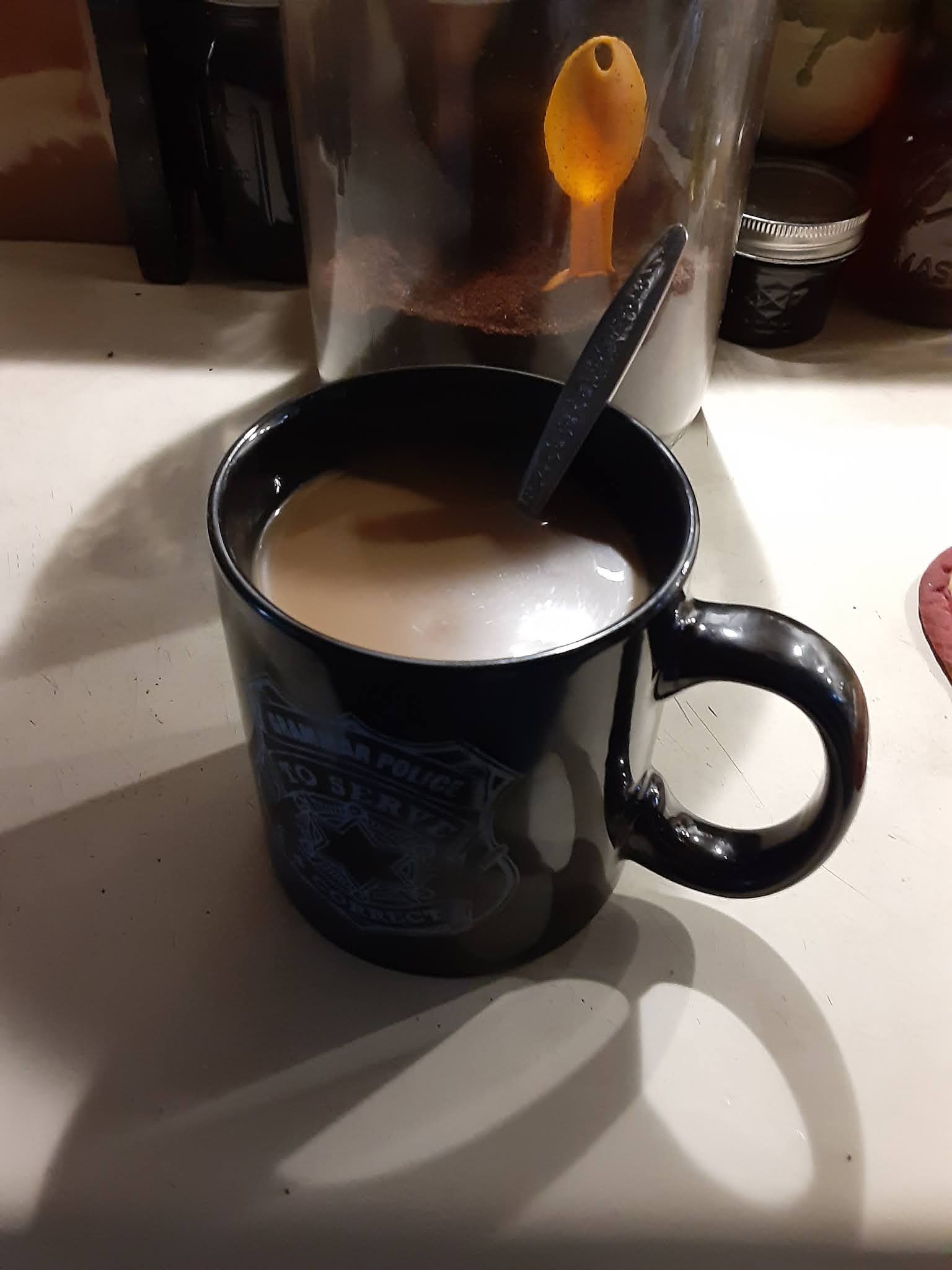
Since I no longer have a coffee maker, I don't have the basket and I don't have paper coffee filters, but I wanted to experiment using things I have right here around the house.  

For my fancy pour over coffee, I used a (clean) cloth napkin and a reused pasta sauce jar.  


I folded the napkin into four layers so that the water wouldn't pass through the grounds too quickly.  I laid the folded napkin over the mouth of the jar and pushed some of it inside the opening to create a little nest.  I wrapped a rubber band around the excess on the outside of the jar to hold the napkin in place.  

I added two tablespoons of grounds to the napkin filter in the jar.  The amount of grounds depends on how strong one likes one's coffee.


Then, I boiled some water and poured it over the grounds.


Et voila!  Coffee.  


No machine.  No fancy equipment.

In fact, using this pour over method, if the water were boiled over an open fire (or on a woodstove, for instance), the only cost to make the coffee would be the cost of the grounds, which means, folks, when your power goes out, you can still have coffee.  All you need is a napkin, some hot water, a jar, and coffee grounds. 

I considered sharing a link to this article on the FB group - so that the young man, who thinks he needs a new coffee maker to get coffee, can learn that he doesn't have to be limited by the belief that there is only one way to do a thing.  There's a lot of room for innovation and creativity outside of the box.


Monday, April 26, 2021

Upcycled Lunch Bag

I love being able to create something from stuff I just have around my house ... and after 20+ years of living in the same place, I'm (almost) embarrassed to admit that we have a LOT of stuff.

Most people know that we have a backyard flock of suburban chickens.  They are pretty amazing for giving us eggs and helping keep the backyard tick-free, but since we give them layer pellets and scratch, we end up with a lot of spare feed sacks.  

Back in my Granny's day, those feed sacks were made of cloth and were repurposed into things like undergarments for my dad and his siblings.  These days, the feed sacks are made from a (recyclable) plastic material.  Sure, it's recyclable, but as many of us are painfully aware, much of the "recyclable" plastic isn't being recycled.  It's one of the reasons we have looked for alternatives to things like bottled drinks.  Sure, we can return the bottles - out of sight, out of mind.  Right?  But the fact is that recycling is the last of the Three R's, because it's the least effective way to deal with our excess of "stuff."  Better is to reuse and/or repurpose.

So, I'm always looking for ways to reuse those feed sacks.  We've used them to winterize the chicken coop and rabbit hutches.  I've used them to grow potatoes.  

And today, I found a new repurpose - a lunch bag.

Deus Ex Machina takes his lunch to work every day.  It's usually leftovers - because I almost always cook too much.  He's had a variety of lunch bags over the years.  The one we purchased for him the most recently (a couple of years ago, now) is starting to show its age in some not really great ways, and so I figured it was time to get him something new.  

Making it rather than buying it is one of my favorite things, and so I decided I would try my hand at making him one out of an empty feed sack.

The lunch bag he has been using has never been quite the correct size.  We reuse those rectangular, plastic take-out containers, and unfortunately, the lunch bag wasn't big enough to allow the take-out container to sit flat on the bottom of the bag.  I remedied that problem with his new bag.  It's the exact size to allow the take-out container to sit flat.  

And it's tall enough that he could take multiple containers (one for salad and one for an entree, maybe) stacked neatly inside the bag.

It was a super fun project, and I'm thinking I will probably make a few more, because why not?  

What I did:

1.  The first step was, of course, to clean the bag, which was easily accomplished by wiping it down with a damp cloth to get the dust from the feed off of it. 

2.  Using the take-out container, I measured the sides of the bag.  As it turns out, the bottom strip on the feedsack was exactly the correct size, and so I just cut out the blue colored strip for the sides and bottom of the lunch bag. 


3.  For the front of the lunch sack, the picture of the chicken was the perfect size.  With the feed bag still, mostly, intact, I cut two pieces (front and back) using the chicken picture as my guide.  


4.  With right-sides together, I pinned everything together and sewed a seam inside the bag, attaching the back and front to the side pieces.  


5.  I folded over the top edge and stitched a hem around the top.

6.  Then, I put a little stitch in the top corner of each seam so that the bag would sit square.

7.  Using one of Deus Ex Machina's old, worn-out, mesh belts, I made a couple of handles, and stitched them on.


Et viola!  A "new" lunch bag for Deus Ex Machina.

At worst, it's a fun conversation piece.  I mean, how many people have a picture of a chicken on their lunch bag?